

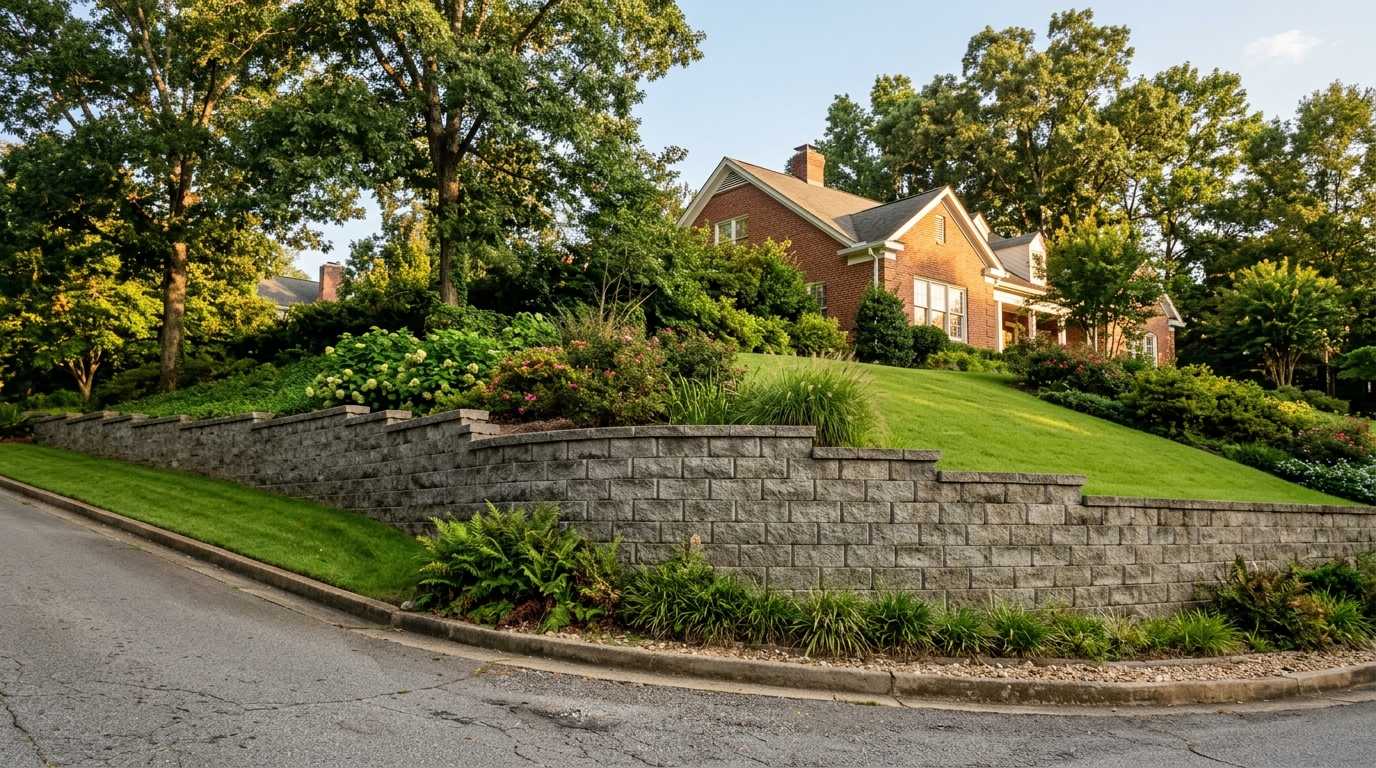
Key Takeaways
- Timber walls are the most affordable upfront option ($15 – $25 per sq ft) but have a limited lifespan of 15 to 20 years.
- Segmental concrete blocks ($25 – $45 per sq ft) offer superior resistance to Homewood's expanding red clay and last up to 100 years.
- Local building codes require stamped structural engineering drawings for any retaining wall exceeding 4 feet in height.
Need Retaining Walls in Homewood?
If you're looking for help in Homewood, visit our dedicated retaining walls page for local service details, project examples, and the next steps for your home.
Managing the Slopes of Homewood: Wood vs. Block Retaining Walls
Homewood's dramatic topography, from the historic ridges of Hollywood to the steep backyards of Mayfair, requires a serious approach to soil retention. When you deal with a sloped lot, choosing between pressure-treated timber and segmental concrete blocks is a major structural commitment. This choice dictates how your property handles Alabama's heavy seasonal rains and constant lateral earth pressure.
Many homeowners look at the immediate cost difference without realizing how our local soils and drainage patterns completely alter the long-term financial math. A budget-friendly wood wall can quickly become a liability if it fails to withstand the immense pressure of saturated red clay. We build retaining walls in Homewood that protect your property boundaries and create flat, usable yard space.
As local contractors, we believe in giving homeowners straightforward, practical advice about materials and trade-offs. Homewood is a premium market where homeowners expect quality materials, experienced crews, and attention to architectural detail. Let's look at the actual costs, structural differences, and local factors so you can make an educated choice for your home.
The Raw Cost Breakdown: Timber vs. Segmental Block Systems
Calculating the true cost of a retaining wall in Homewood requires looking at both the upfront installation price and the eventual replacement cycle. Retaining wall cost is calculated by the square footage of the wall face, which is the length multiplied by the height. The choice of material is the primary driver of this final number.
The table below outlines standard total investment tiers for the most common materials we install across Jefferson County. These ranges include excavation, gravel foundation trenching, block or timber assembly, drainage pipes, and structural backfill.
| Material Option | Cost per Sq Ft (Wall Face) | Expected Lifespan | Best Application |
|---|---|---|---|
| Pressure-Treated Timber | $15 – $25 | 15 – 20 Years | Low garden walls, short terracing |
| Segmental Concrete Block (SRW) | $25 – $45 | 50 – 100 Years | Structural slope retention, tiered yards |
| Natural Stacked Stone | $40 – $75+ | 75 – 100+ Years | Premium historic districts, luxury curb appeal |
To put these numbers into perspective, a low garden wall of about 60 square feet typically runs between $1,200 – $3,000 total. If you are tackling a more complex slope terracing project of roughly 180 square feet, expect to pay between $3,500 – $9,000 total. For major structural walls exceeding 400 square feet, the cost usually ranges from $12,000 – $35,000+ because these projects require specialized engineering, deep excavation, and municipal permits.
Three Overlooked Realities of Sloped Retaining Walls in Jefferson County
Building a successful retaining wall on a Homewood slope requires addressing three specific physical and regulatory realities that many budget contractors fail to mention. Our local terrain is beautiful, but it presents engineering challenges that cannot be ignored.
- Hydrostatic Pressure and Red Clay: Alabama's dense red clay absorbs moisture like a sponge, expanding and exerting immense pressure when saturated. Without deep-set gravel backfill and filter fabric, this expanding clay will push a wood or unreinforced block wall out of alignment within a few seasons.
- The Four-Foot Engineering Threshold: Local building codes mandate that any retaining wall exceeding 4 feet in height must have stamped structural engineering drawings. Bypassing this step to save money puts you at risk of city fines, HOA disputes, and catastrophic structural failure.
- The True Cost of Lifespan Differences: While pressure-treated timber is an economical option upfront, it will eventually rot and require a full section rebuild costing $4,000 – $10,000+. Segmental concrete blocks are impervious to rot and termites, offering the highest long-term return on investment.
If you want to explore different aesthetic layouts for your property, check out our guide on retaining wall design ideas. Understanding these design options helps you plan a layout that matches both your budget and your home's architectural style.
Why Timber Walls Fail Early on Homewood's Shaded Ridge-Side Lots
Wood structures placed in direct contact with damp soil face a constant uphill battle against organic decay. While we use heavy 6x6 timbers pressure-treated for ground contact, wood is still an organic material. In heavily wooded neighborhoods like Edgewood or Hollywood, the soil stays damp for days after a heavy summer storm.
Over time, this constant moisture exposure leads to fungal decay and wood rot. Termites, which thrive in our warm Central Alabama climate, also target older timber walls. Once the wood begins to soften, the structural integrity collapses. A leaning section with drainage issues can cost $1,000 – $3,500 to stabilize temporarily, but eventually, you will face a complete replacement.
If your property has existing outdoor features like custom decks or high-end privacy fences, a failing wood wall can undermine their foundations as well. This leads to much larger repair bills across your entire property. You can read more about the physics behind these failures in our article on retaining wall engineering.
Expert Field Note from Justin Johnson: On sloped properties across Homewood, we repeatedly see timber walls fail because the installer skipped the gravel backfill to save on material costs. When red clay sits directly against wood, the wall acts like a dam, trapping water until the pressure snaps the deadman anchors. We always install a minimum of 12 inches of clean, washed stone wrapped in filter fabric behind every wall we build.
Segmental Block Walls: The Engineered Shield Against Clay Expansion
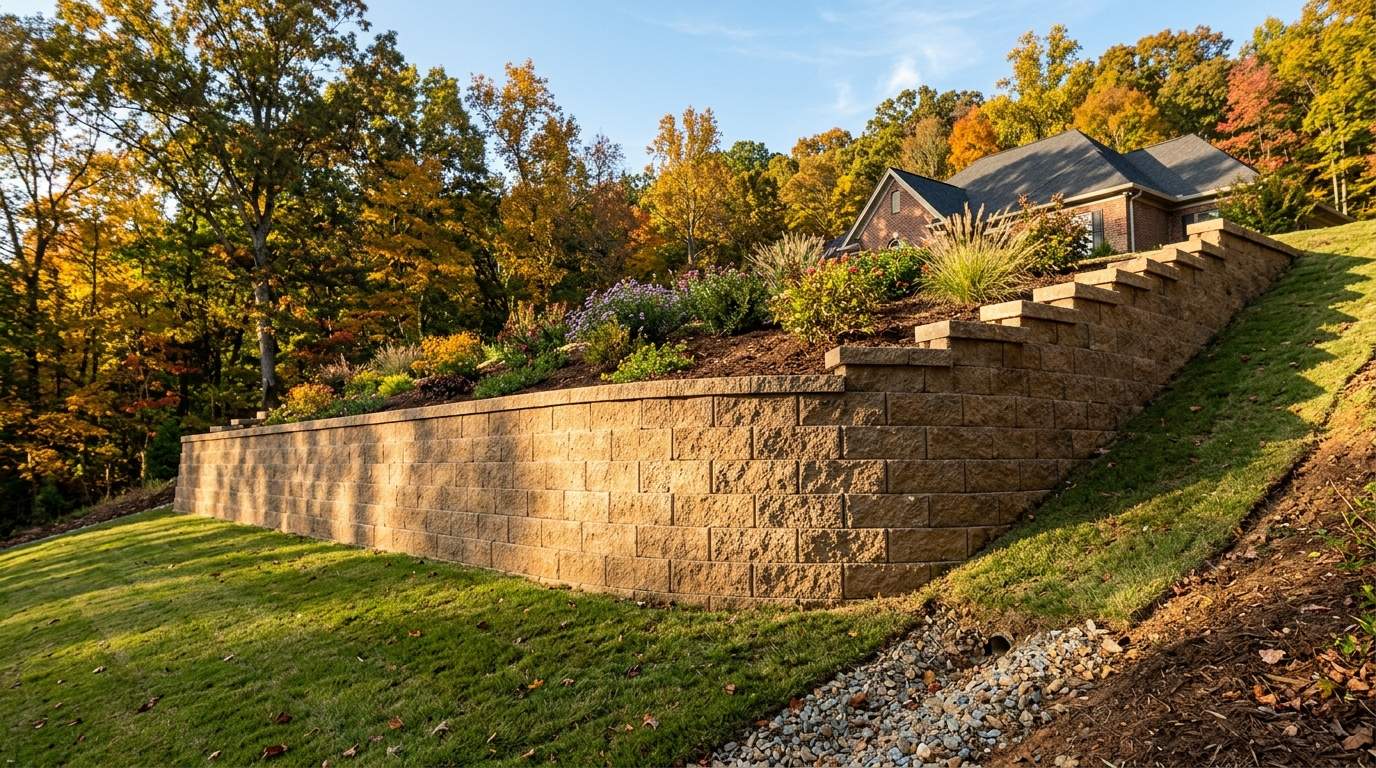
Interlocking concrete systems provide the ultimate defense against Homewood's expanding red clay because they are engineered to flex and drain naturally. These interlocking systems do not rely on mortar, which can crack as the ground shifts. Instead, they use physical shear pins or lip connections that allow the wall to adapt to minor soil movements without losing structural strength.
For homeowners looking to maximize their outdoor space, segmental blocks allow us to build taller, more secure walls using geogrid soil reinforcement. We wrap our drainage zones in professional-grade geotextiles to prevent fine clay particles from clogging the system. This ensures that water drops quickly to the French drains and weep holes rather than saturating the soil behind the wall.
If you are planning other exterior upgrades, such as a new siding installation to boost your home's curb appeal, stabilizing your sloped yard first ensures your home's foundation remains secure. We offer flexible financing options to help homeowners manage these essential structural investments without compromising on material quality.
Frequently Asked Questions
How much does it cost to repair a leaning retaining wall in Homewood?
Repairing a leaning section and correcting the underlying drainage issues typically costs between $1,000 – $3,500. We must first diagnose the hydrostatic pressure causing the lean and install proper gravel backfill and weep holes to prevent future movement.
What is the lifespan difference between wood and block retaining walls?
Pressure-treated timber walls generally last 15 to 20 years before rot and insect damage require replacement. In contrast, engineered segmental concrete block walls easily last 50 to 100 years with minimal maintenance.
Do I need a permit to build a retaining wall in Homewood, AL?
You do not need a permit for gravity walls under 4 feet tall in Homewood. However, any wall 4 feet or taller requires stamped engineering drawings and a municipal building permit to ensure structural safety.
Can a failing retaining wall damage my home's foundation?
Yes, a failing wall on a steep slope can cause soil erosion that undermines your home's foundation footings or adjacent structures like decks. Addressing a failing wall early prevents incredibly expensive structural repairs down the road.
The High Cost of Delaying Slope Stabilization in Homewood
Postponing the replacement of a failing retaining wall allows continuous soil erosion to slowly wash away the ground supporting your yard, patios, and foundation. Saturated clay will continue to push against the weakened structure, multiplying the eventual restoration costs and destroying your usable yard space. Schedule a professional property evaluation with Patriot Roofing & Builders today to secure your slope before the next heavy storm season arrives.
Ready to stop researching and get real answers?
If this article helped you spot a roofing, siding, or gutter issue, the next step is simple. Get honest guidance, a professional inspection, and a clear plan from the Patriot Roofing team.
Justin Johnson
Owner / Licensed Home Builder
Justin is the Co-Owner of Patriot Roofing & Builders and a Licensed Alabama Home Builder. With extensive experience in high-performance exterior systems and storm restoration, he brings a hands-on, technical perspective to every project across the Greater Birmingham area.
More About UsYou Might Also Like
Why Timber Walls Rot Fast in Homewood, AL
