

Key Takeaways
- Wet Red Clay: Homewood's dense clay soil traps moisture directly against timber, accelerating wood rot.
- Hydrostatic Pressure: Heavy seasonal rains create immense lateral force that pushes against and weakens wood structures.
- Long-Term Costs: While cheaper initially, timber walls require replacement every 10 to 15 years, making concrete or stone more cost-effective.
Need Retaining Walls in Homewood?
If you're looking for help in Homewood, visit our dedicated retaining walls page for local service details, project examples, and the next steps for your home.
The Reality of Timber Walls on Homewood Slopes
Timber walls rot rapidly in Homewood because of the combination of poorly draining red clay, high subterranean moisture, and extreme summer humidity. While wood structures offer an initial cost savings, the local environment in Jefferson County actively works to break down organic materials. Homeowners in established neighborhoods like Hollywood and Edgewood often discover their legacy wood walls bowing or decaying long before they expect.
Early fall is the ideal time to evaluate these structures before winter rains saturate the ground. When we inspect properties near the Shades Creek basin or Mayfair, we consistently find that timber structures simply cannot handle the moisture levels. Over time, the pressure-treated chemicals leach out of the wood, leaving the fibers vulnerable to localized fungi and subterranean termites.
If you are noticing shifting soil on your property, installing durable retaining walls in Homewood is the most reliable way to protect your landscape. Look for these early indicators of wood wall failure:
- Fungal growth or mushrooms sprouting from the wood joints
- Soft, spongy spots when probed with a metal tool
- Visible bowing or leaning near the base of the wall
The Mechanics of Wood Rot in Alabama Red Clay
Alabama's dense red clay acts like a sponge, holding water directly against the timber face with no escape path. Unlike sandy soils that allow water to drain away quickly, clay particles pack tightly together. This creates a highly saturated underground environment that keeps timber in constant contact with moisture.
Even wood treated for ground contact eventually succumbs to this relentless moisture exposure. When the clay expands during heavy spring storm seasons, it puts immense lateral pressure on the wall, forcing wet soil into every microscopic crack in the timber. We covered this soil dynamic in detail in our guide on Why Retaining Walls Fail in Homewood's Expanding Clay Soil.
Expert Field Note from Justin Johnson: When we inspect older timber walls in neighborhoods like Edgewood, we almost always find that the installer skipped the gravel backfill entirely. Without a thick layer of clean stone to let water drop, the wet clay stays glued to the wood, and even ground-contact rated 6x6s will turn to mush within eight to ten years.
Why Standard Drainage Systems Fail Timber Structures
Standard timber walls rarely feature the robust drainage pathways required to handle Homewood's intense precipitation. Most budget installations lack the geotextile fabrics, French drains, and gravel backfill needed to divert water. Without these components, water pools behind the wood, building up intense hydrostatic pressure that compromises both the wood and the structural alignment.
When water has no clear path of escape, it forces its way through the seams between the timbers. This constant flow washes out the soil behind the wall and keeps the timber saturated year-round. To understand how proper water management protects your yard, read our comparison on Weep Holes vs Drains For Wet Clay Yards in Homewood, AL.
Timber wall drainage typically fails due to several common installation oversights:
- Clogged filter fabric from fine clay silt
- Lack of a dedicated French drain pipe at the footing
- Absence of clean gravel backfill behind the timber face
Cost Comparison: Timber vs. Durable Alternatives
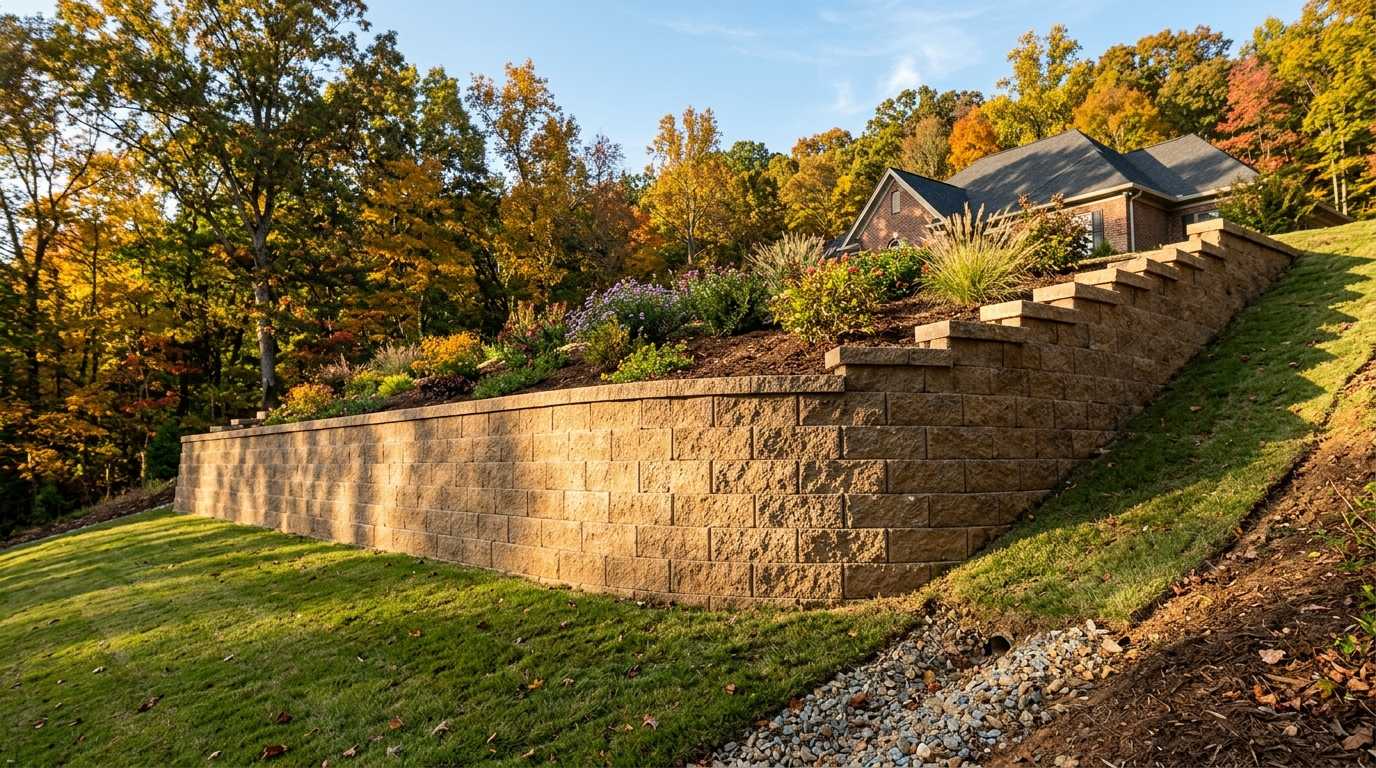
While timber walls have a lower upfront cost, their short lifespan makes them far more expensive over time compared to concrete block or natural stone. A wood wall typically lasts 10 to 15 years in our climate, whereas engineered block systems easily surpass 50 years. When you factor in the cost of demolition and replacement, timber becomes a highly inefficient long-term investment.
For homeowners looking to compare upfront costs against long-term value, we break down the typical investment tiers for Homewood properties below. You can find additional pricing details in our comprehensive analysis of Wood vs Block Wall Costs for Slopes in Homewood, AL.
| Material Option | Average Cost (Per Sq Ft) | Expected Lifespan | Maintenance Level |
|---|---|---|---|
| Pressure-Treated Timbers | $15 – $25 | 10 – 15 Years | Moderate |
| Segmental Concrete Block | $25 – $45 | 50 – 100 Years | Low |
| Natural Stacked Stone | $40 – $75+ | 75 – 100+ Years | Low |
A typical slope terracing project of about 180 square feet costs between $3,500 – $9,000, depending on the material selected. For smaller decorative projects, a low garden wall of approximately 60 square feet generally ranges from $1,200 – $3,000 total.
Frequently Asked Questions
How long do timber retaining walls last in Homewood?
In our local climate, a pressure-treated timber retaining wall typically lasts 10 to 15 years before rot and termite damage require a rebuild. In areas with highly saturated red clay and poor drainage, this lifespan can shrink to under 8 years.
Can you repair a rotting wood retaining wall?
Repairing a rotting wood wall is rarely a long-term solution because the decay spreads throughout the entire structural frame. While a leaning section with minor drainage issues can sometimes be stabilized for $1,000 – $3,500, replacing the failing timber with segmental concrete blocks is usually the most cost-effective path.
What is the best alternative to a timber wall in Jefferson County?
Segmental concrete blocks are the best all-around alternative, offering a lifespan of 50 to 100 years at a moderate price range of $25 – $45 per sq ft. For historic neighborhoods like Hollywood, natural stacked stone provides unmatched architectural continuity despite its higher upfront cost.
Choosing a Permanent Solution for Your Homewood Property
Replacing a failing timber wall with concrete blocks or natural stone eliminates the cycle of rot and permanently stabilizes your yard. At Patriot Roofing & Builders, we design and build hardscaping solutions engineered to withstand the unique lateral pressures of Alabama's hillside terrain. We handle the entire process, including engineering coordination, municipal permitting, and drainage design, to ensure your new wall stands for decades.
We also coordinate your hardscaping with other exterior improvements to maximize your property's value. If you want to secure your perimeter completely, our team can install custom decks or work with a skilled fence contractor in Homewood to build a matching privacy fence. For design inspiration on your next project, explore our guide on 5 Retaining Wall Design Ideas for Homewood, AL.
Walk down to the lowest timber on your wall and firmly press the tip of a flathead screwdriver into the wood near the soil line. If the metal sinks more than half an inch into the wood without resistance, you should schedule a professional site evaluation to assess the wall's structural integrity.
Ready to stop researching and get real answers?
If this article helped you spot a roofing, siding, or gutter issue, the next step is simple. Get honest guidance, a professional inspection, and a clear plan from the Patriot Roofing team.
Justin Johnson
Owner / Licensed Home Builder
Justin is the Co-Owner of Patriot Roofing & Builders and a Licensed Alabama Home Builder. With extensive experience in high-performance exterior systems and storm restoration, he brings a hands-on, technical perspective to every project across the Greater Birmingham area.
More About UsYou Might Also Like

Weep Holes vs Drains For Wet Clay Yards in Homewood, AL
