


Key Takeaways
- Hydrostatic pressure is the primary cause of retaining wall failure in Homewood's heavy red clay soils.
- Weep holes provide localized pressure relief but easily clog without professional-grade geotextile fabric and gravel backfill.
- Subsurface French drains offer a comprehensive water management solution for steep, sloped yards facing heavy seasonal runoff.
Need Retaining Walls in Homewood?
If you're looking for help in Homewood, visit our dedicated retaining walls page for local service details, project examples, and the next steps for your home.
Managing Wet Clay Behind Homewood Retaining Walls
A homeowner typically calls us after noticing a slight tilt in their backyard masonry or finding a pool of standing water that refuses to drain after a spring storm. By the time we arrive at these sloped properties in areas like Edgewood or Mayfair, the homeowner has usually already tried clearing surface mud multiple times, unaware that the real threat is hidden directly behind the wall face. Saturated soil exerts immense hydrostatic pressure, particularly when dealing with the heavy, expansive red clay characteristic of Jefferson County. Many people assume a few simple weep holes will relieve this massive physical burden, while others believe they need a complex, expensive French drain system. Resolving this issue requires understanding how these two drainage methods function under real-world conditions.
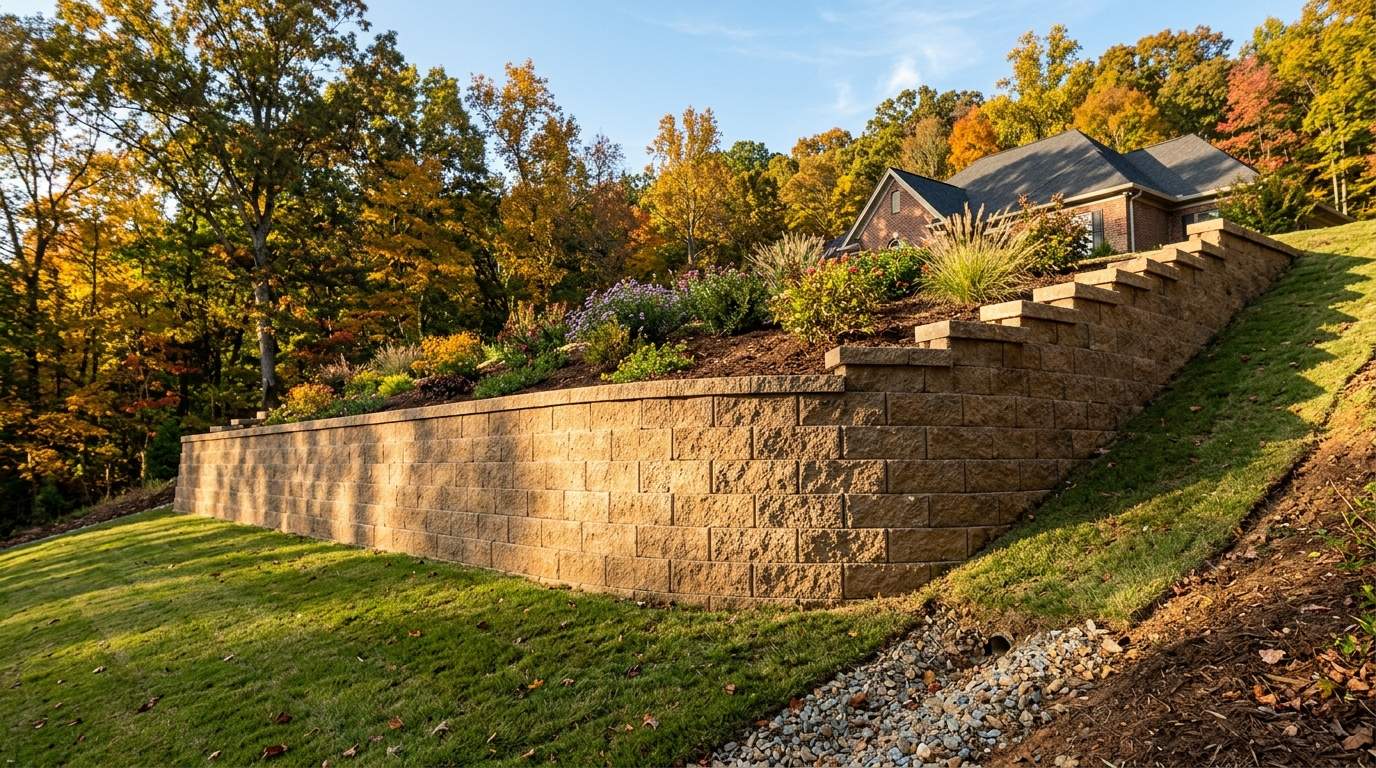
Homewood features steep topography and ridge-side lots that naturally channel stormwater down toward home foundations. When constructing retaining walls in Homewood, managing this water is not an afterthought but the foundation of the entire engineering plan. Without a dedicated pathway for moisture to escape, wet clay expands and pushes against the back of the wall, eventually causing bowing, cracking, or complete structural failure. Early fall provides the dry, temperate weather window required to excavate these slopes and install proper drainage before winter rains saturate the clay.
How Weep Holes Work in Alabama Clay
Weep holes are small openings built directly into the base of a retaining wall to allow trapped water to escape from the backfill area. In standard masonry or concrete block systems, installers place these openings at regular intervals along the bottom course of the wall. Water trickles through the gravel backfill, hits the impervious footing, and exits through these holes rather than building up behind the face. For simple gravity walls or low garden borders, a series of well-placed weep holes can provide sufficient localized relief.
However, Alabama's dense red clay presents a major obstacle for basic weep holes. Clay particles are exceptionally fine and easily migrate with water, slowly filling the void spaces in the gravel backfill and plugging the weep holes from the inside. When we perform a minor repair to reset, repoint, or clear clogged weep holes, which typically costs between $200 and $800, we often find the openings packed solid with hardened clay. To prevent this, professional builders must wrap the gravel backfill zone in high-quality geotextile filter fabric to block clay sediment while allowing water to pass through freely.
Why Subsurface Drains Beat Hydrostatic Pressure
Subsurface drainage systems, primarily French drains, utilize perforated pipes buried in a gravel trench to collect and redirect large volumes of water away from the wall foundation. Instead of relying on water finding its way to small openings in the wall face, a subsurface drain provides a continuous, high-capacity channel running the entire length of the structure. This pipe slopes gently toward a safe discharge point, such as a street gutter or a designated drainage swale, keeping the water entirely away from the wall's structural components.
For homes built on the steep slopes of Hollywood or Mayfair, subsurface drains are essential for long-term stability. The sheer volume of runoff during heavy seasonal storms can quickly overwhelm simple weep holes, leading to rapid soil saturation. Installing a subsurface drain relieves hydrostatic pressure uniformly across the entire height and length of the wall, preventing the localized wet spots that cause structural shifting. If your wall is already showing signs of distress, addressing a leaning section and installing proper subsurface drainage typically costs between $1,000 and $3,500, depending on the wall's height and accessibility.
To learn more about how soil characteristics impact these structural choices, you can read our detailed guide on Why Retaining Walls Fail in Homewood's Expanding Clay Soil.
Comparing Weep Holes vs. Drains for Clay Soils
While weep holes provide localized pressure relief, subsurface drains manage the entire volume of water flowing down a sloped Homewood yard. Choosing the right method depends on several factors, including the height of your wall, the slope of your property, and the specific composition of your soil. In many cases, the most robust engineering design combines both methods to create a redundant system that ensures water never accumulates behind the structure.
| Drainage Feature | Primary Function | Best For | Clay Soil Performance |
|---|---|---|---|
| Weep Holes | Localized pressure relief at the wall base | Low garden walls under 3 feet | Moderate (prone to clogging without filter fabric) |
| Subsurface Drains | Continuous water collection and redirection | Structural walls and steep slopes | Excellent (prevents water from pooling behind clay) |
| Combined System | Redundant water management and maximum safety | Engineered walls over 4 feet | Superior (recommended for high-load areas) |
When planning your landscape layout, you must also consider how material choices affect drainage pathways. For instance, segmental concrete blocks have built-in drainage paths through their interlocking joints, whereas solid poured concrete walls rely entirely on engineered weep holes and pipes. For a breakdown of how material selection impacts your overall budget, see our companion article on Wood vs Block Wall Costs for Slopes in Homewood, AL.
Expert Field Note from Justin Johnson: On older brick and natural stone walls around Homewood, we often see weep holes completely packed with hardened red clay. The giveaway is a white, powdery salt deposit, efflorescence, forming on the front of the wall, which tells you water is trapped inside the structure with nowhere to go.
The Cost of Drainage Failures and Rebuilds
Failing to install proper drainage behind a retaining wall eventually leads to structural failure, requiring expensive repairs or a complete rebuild. Over time, the relentless expansion of wet clay pushes the wall forward, breaking mortar joints and tilting heavy blocks out of alignment. Once a wall loses its structural integrity, simple drainage retrofits are no longer sufficient to guarantee safety.
The financial consequences of ignoring drainage issues are significant. While addressing a leaning section and adding proper drainage early on costs between $1,000 and $3,500, a complete section rebuild typically ranges from $4,000 to $10,000 or more. For large-scale sloped properties requiring a major structural wall exceeding 400 square feet, homeowners can expect total investment tiers of $12,000 to $35,000+, especially since any wall over 4 feet in Homewood requires stamped engineering drawings and municipal permits. Managing water before it reaches your wall with proper gutter installation in Homewood or coordinating the runoff around privacy fences in Homewood can drastically reduce the load on your retaining structures.
Frequently Asked Questions
How do I know if my retaining wall drainage is failing?
Look for water pooling at the base of the wall, water weeping through mortar joints instead of designated weep holes, or visible bowing and tilting of the wall face. The presence of white, powdery efflorescence on the stone or brick is also a clear sign of trapped moisture behind the structure.
Do all retaining walls in Homewood require permits?
In Homewood, any retaining wall that exceeds 4 feet in height from the bottom of the footing to the top of the wall requires stamped structural engineering drawings and a municipal building permit. Working with a licensed homebuilder ensures your wall meets all local geotechnical codes and property setback guidelines.
Can I add weep holes to an existing concrete block wall?
Yes, we can core-drill weep holes into an existing concrete or masonry wall to relieve hydrostatic pressure. However, because we cannot easily install filter fabric behind an existing wall, these retrofitted holes must be carefully maintained and cleared of clay sediment periodically.
How does Homewood's red clay affect drainage pipe selection?
Standard perforated pipes with large slots can easily clog with fine clay particles. We use rigid, perforated PVC pipes wrapped in a professional-grade geotextile sleeve and surrounded by clean, washed gravel to ensure clay sediment cannot enter and block the drainage line.
Evaluating Your Yard's Drainage System
Determining the right drainage solution for your sloped yard involves assessing both surface runoff and soil saturation levels. Walk along the base of your retaining wall after the next heavy rainstorm and check if water is pooling at the foundation or if the weep holes are completely dry while the soil behind is saturated. Finding dry weep holes alongside soggy, shifting soil indicates a clogged system that needs a professional assessment to prevent structural failure.
Ready to stop researching and get real answers?
If this article helped you spot a roofing, siding, or gutter issue, the next step is simple. Get honest guidance, a professional inspection, and a clear plan from the Patriot Roofing team.
Justin Johnson
Owner / Licensed Home Builder
Justin is the Co-Owner of Patriot Roofing & Builders and a Licensed Alabama Home Builder. With extensive experience in high-performance exterior systems and storm restoration, he brings a hands-on, technical perspective to every project across the Greater Birmingham area.
More About UsYou Might Also Like
Why Timber Walls Rot Fast in Homewood, AL
