Key Takeaways
- Daily temperature swings across Central Alabama force rigid metal panels to expand and contract, warping sheets that lack sliding expansion clips or proper perimeter clearance.
- Exposed-fastener systems typically cost $5 to $8 per square foot, while concealed-fastener standing seam systems run $9 to $14 per square foot and eliminate screw-hole elongation.
- Correcting buckled panels early costs $150 to $600 for minor adjustments, preventing major structural interventions that range from $1,900 to $3,500.
Need Metal Roofing in Birmingham?
If you're looking for help in Birmingham, visit our dedicated metal roofing page for local service details, project examples, and the next steps for your home.
How Daily Temperature Swings Affect Metal Roofs in Jefferson & Shelby Counties
Steel roofing sheets warp across Central Alabama when installers pin them down tightly without accounting for daily solar expansion and nighttime cooling. During our mid-fall transition, crisp mornings in Vestavia Hills quickly give way to warm afternoon sun, creating rapid thermal cycling across the roof plane. A continuous steel panel running from the ridge cap to the eave physically lengthens as it absorbs direct solar radiation, then shrinks back as temperatures drop after sundown.
When a roofing crew locks both ends of a long metal panel directly to the wooden decking without expansion relief, that growing steel has nowhere to go. The trapped linear tension forces the flat metal between the vertical ribs to bow upward or ripple in a wave-like distortion known in the trade as oil canning. Across the metal roofs our team inspects in the Birmingham area, improper fastening during the original installation remains the primary cause of wavy, distorted panels.
Preventing this structural distortion requires engineering the roof assembly to float naturally over the deck. Homeowners exploring metal roofing in Birmingham must choose between two distinct fastening methods that handle Alabama's thermal stress in very different ways.
Why Exposed-Fastener Systems Buckle Under Alabama Heat and Humidity
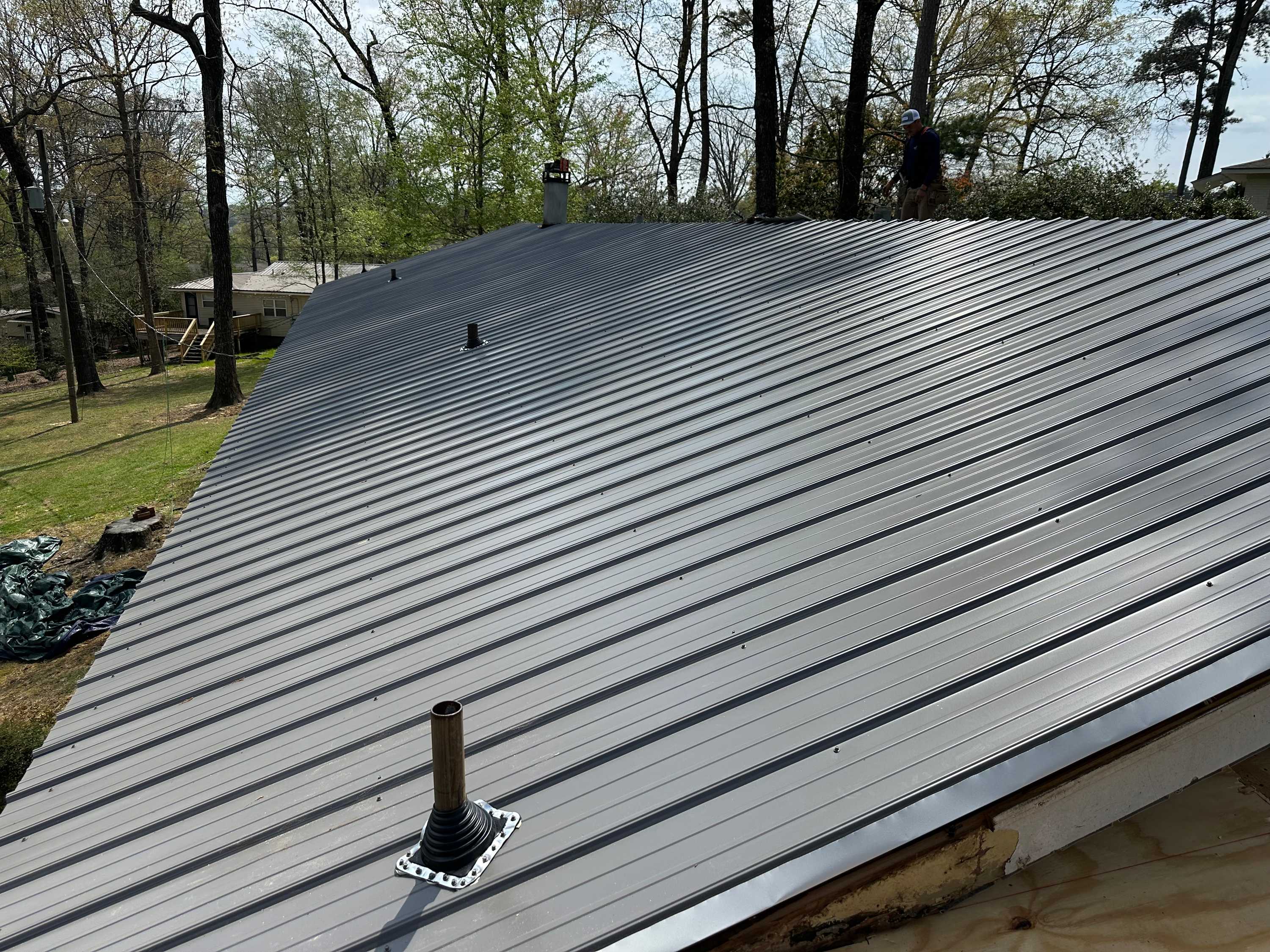
Exposed-fastener metal roofs buckle and leak over time because thousands of screws penetrate directly through the flat face of the steel panels into the wood substrate below, pinning the metal in place. As the panel heats up and tries to slide fractions of an inch down the slope, the steel pushes hard against the rigid shanks of those fixed screws. Over several seasons of thermal cycling, that constant lateral pressure wallows out the screw holes in the metal sheet and bends the fasteners at an angle.
Central Alabama's heavy humidity and autumn leaf drop compound this mechanical stress. On shaded lots in Mountain Brook and Hoover, falling oak leaves and pine needles catch on the raised hex heads of exposed screws, trapping morning dew against the neoprene rubber washers. While trapped attic moisture creates its own problems, which we covered in detail in our breakdown on how high humidity warps metal roof decks in Birmingham, AL, exterior debris combined with intense UV exposure bakes those rubber washers until they turn brittle and crack. Once the washer fails and the screw hole stretches into an oval slot, rainwater pours straight into the decking while the panel binds up and warps between the fastener rows.
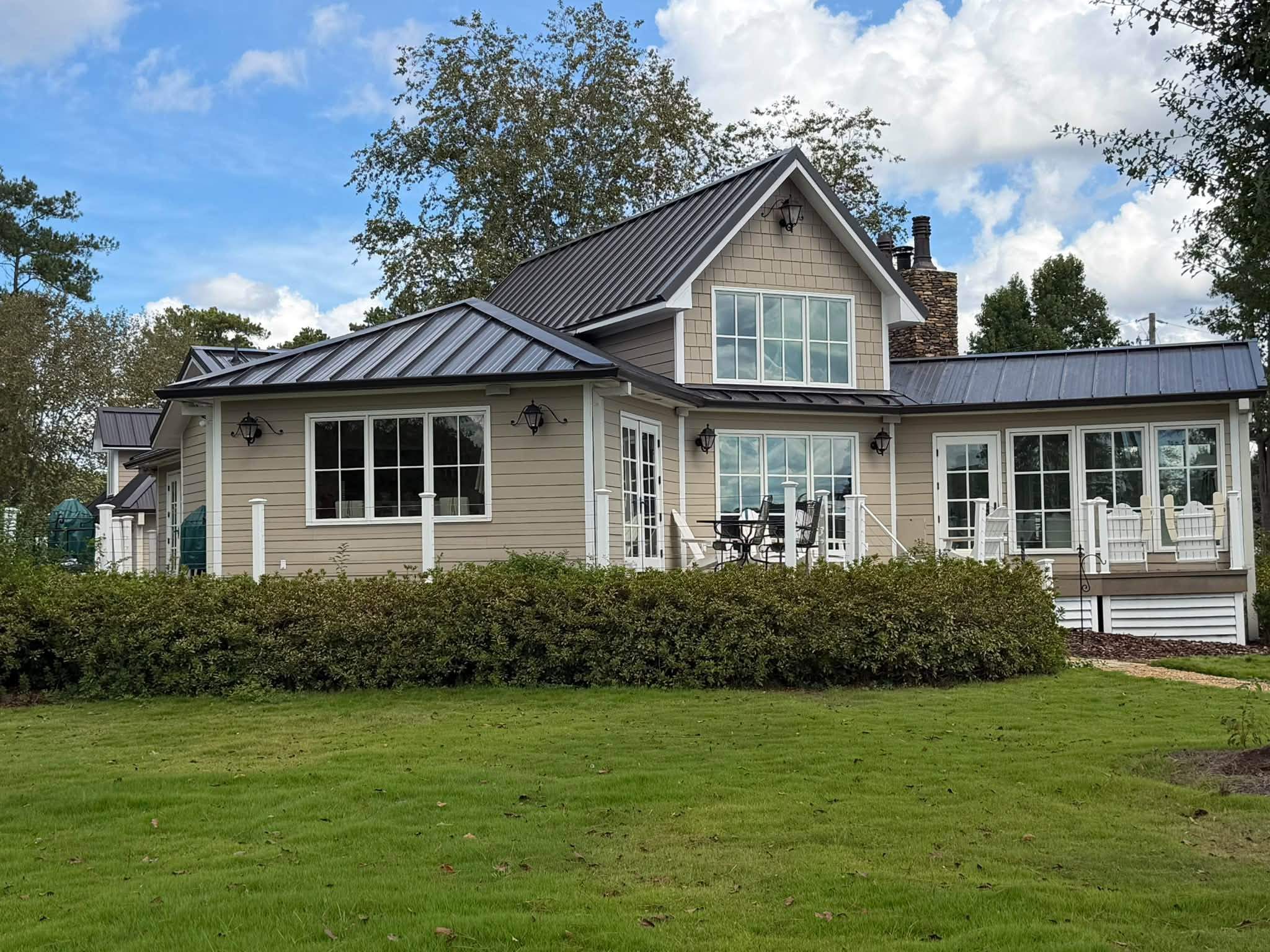
Standing seam architecture solves this mechanical conflict by removing through-panel screws entirely. Installers anchor standing seam panels using concealed clips that hook into the raised vertical ribs, allowing the steel sheet to glide smoothly back and forth over the clip base as the sun heats the surface. We utilized this exact floating mechanism on a recent waterfront standing seam installation on Lay Lake, where dark standing seam metal panels run continuously down steep gables and lower slopes across both the main house and boathouse without pinning the metal to the deck.
Expert Field Note from Justin Johnson: On older ranch homes and steep gables across Jefferson County, we repeatedly see warped metal panels caused by installers driving screws tight through the flat pan right at the eave and ridge transitions. When a long panel cannot slide a fraction of an inch during a sunny afternoon, it pops the fasteners out of the OSB decking and creases the steel midway down the slope.
Comparing Standing Seam and Exposed-Fastener Performance and Costs
Choosing between standing seam and exposed-fastener systems comes down to balancing your upfront budget against long-term maintenance and thermal freedom. In the Birmingham metro, most homeowners pay between $5 and $8 per square foot for an exposed-fastener corrugated roof, whereas a concealed-fastener standing seam system typically costs $9 to $14 per square foot.
To see how these two profiles stack up in our climate, review the comparison below:
| System Type | Typical Birmingham Cost | Thermal Movement Design | Maintenance Needs |
|---|---|---|---|
| Standing Seam | $9 – $14 per sq ft | Concealed sliding clips allow uninhibited panel expansion | Virtually zero fastener maintenance; smooth surface sheds leaves |
| Exposed-Fastener / Corrugated | $5 – $8 per sq ft | Pinned directly to deck; relies on washer compression | Requires periodic screw retightening and washer replacement |
Investing in a standing seam system upfront eliminates the recurring labor costs of climbing onto the roof to replace backed-out screws and degraded washers. You can estimate the baseline investment for your specific roof footprint using our roofing cost calculator before deciding which profile fits your long-term plans.
Installation Details That Prevent Panel Distortion
Preventing thermal warping requires strict adherence to clip spacing, substrate preparation, and custom flashing tolerances during installation. Even a premium standing seam panel will ripple if the crew lays it over an uneven wood deck or pinches the metal tight against a brick chimney. Every metal installation our sheet metal crews complete follows four non-negotiable mechanical steps so each panel lies flat through every season:
- High-Temperature Synthetic Underlayment: Standard felt paper degrades and sticks to the underside of hot steel, dragging on the panel as it tries to expand; high-temp synthetic sheets provide a slick, heat-resistant slip plane.
- Precision Clip Alignment: Concealed clips must align in a dead-straight line from eave to ridge so the raised vertical rib never binds as the metal slides.
- Expansion Gap Clearances: Installers must leave a measured gap inside the ridge cap and Z-closure flashing so lengthening panels never bottom out against framing members.
- Custom Relief Flashing: Valleys, dormers, and stone chimneys require two-piece reglet or counter-flashing that overlaps the roof panels without pinning them down with rigid cross-screws.
When a homeowner calls us for roof repair in Birmingham to fix a noisy, popping, or visibly wavy metal roof, the root cause is almost always a violation of one of those four rules. Catching a pinched trim detail early allows a technician to relieve the pressure before the steel suffers a permanent crease.
Repairing vs. Replacing Warped Metal Panels in Birmingham
Deciding whether to repair or replace warped metal panels depends on whether the steel has merely bowed under tension or permanently creased and torn around the fasteners. When a panel exhibits mild oil canning or has a few backed-out screws along the eave, a minor repair typically costs between $150 and $600 to seal a panel gap, apply a small patch, or upgrade the fasteners with oversized neoprene-washer screws.
When thermal movement has elongated dozens of screw holes along a long valley run or pulled flashing away from a brick wall, a typical repair runs $600 to $1,900. However, if trapped expansion has buckled multiple sheets across a wide slope, creasing the ribs so severely that wind-driven rain blows sideways under the laps, a major repair replacing multiple panels and recoating the section typically costs $1,900 to $3,500. Before authorizing patchwork on a severely buckled roof, always schedule a thorough evaluation with certified roof inspectors to verify whether the wood decking underneath has rotted from slow fastener leaks.
If an older exposed-fastener roof has reached the point where every panel is rippled and leaking at the washers, paying for repeated sectional repairs wastes money. Stepping up to a full roof replacement in Birmingham with a properly clipped standing seam system stops the cycle permanently, and we offer flexible financing options to help homeowners bridge the gap between budget corrugated metal and lifetime standing seam protection.
Frequently Asked Questions
What is oil canning on a metal roof and does it cause leaks?
Oil canning is the visible waviness or slight buckling that appears in the flat areas of metal roofing panels between the vertical ribs. While cosmetic oil canning on a standing seam roof does not cause leaks by itself, severe warping caused by pinned thermal expansion on an exposed-fastener roof will stretch screw holes and let water into your home.
How much does it cost to fix warped or leaking metal roof panels in Birmingham?
Minor metal roof repairs in Birmingham typically cost $150 to $600 to replace backed-out fasteners and seal small panel gaps. Typical repairs involving flashing adjustments run $600 to $1,900, while major repairs requiring multiple panel replacements and sectional recoating range from $1,900 to $3,500.
Why does my metal roof make popping noises when the sun comes out?
Popping or groaning noises happen when solar heat causes metal panels to expand while tight screws or pinched trim hold the steel in place. When the built-up thermal pressure overcomes the friction of the fasteners, the metal shifts suddenly against the wood deck, creating an audible pop.
Is standing seam metal roofing worth the extra cost over screwed-down panels?
Yes, standing seam metal roofing ($9 to $14 per square foot) is worth the upgrade over exposed-fastener metal ($5 to $8 per square foot) for primary residences in Central Alabama. Concealed clips allow the panels to expand and contract freely without wearing out rubber washers or stretching screw holes, eliminating recurring maintenance.
Inspecting Your Roof Line Before Temperatures Drop
There is nothing better than pulling into your driveway and seeing a crisp, flat metal roof that makes your whole house look architectural and secure. Stand at the corner of your yard during the warmest part of a sunny afternoon and sight down the lower eave edge above your seamless gutter installation to see whether the flat pans between the ribs look wavy or if any screw heads are sitting crooked against the metal. If you spot rippled panels or lifted fasteners, schedule a professional evaluation with Patriot Roofing & Builders so we can relieve the thermal tension before winter rains work through the gaps.
Ready to stop researching and get real answers?
If this article helped you spot a roofing, siding, or gutter issue, the next step is simple. Get honest guidance, a professional inspection, and a clear plan from the Patriot Roofing team.
Justin Johnson
Owner / Licensed Home Builder
Justin is the Co-Owner of Patriot Roofing & Builders and a Licensed Alabama Home Builder. With extensive experience in high-performance exterior systems and storm restoration, he brings a hands-on, technical perspective to every project across the Greater Birmingham area.
More About UsMetal Roofing in Birmingham
 16 photos
Standing Seam Metal Roof on Lay Lake in Wilsonville, AL
Lay Lake, Wilsonville
This waterfront residence on Lay Lake in Wilsonville received a complete metal roofing update across all roof planes, extending from the main house to the boathouse structure. Dark standing seam metal panels replaced the previous roofing material, running continuously down the steep gables and lower slopes. The dark metal finish pairs directly with the home's tan lap siding, shake-accented gables, and stacked stone chimney. Matching metal trim and custom flashing were integrated around every valley, window header, and chimney transition. This comprehensive roof replacement provides enhanced durability against lakefront elements for the Birmingham-area home.
 9 photos
Standing Seam Metal Roof in Glen Iris, Birmingham, AL
Glen Iris
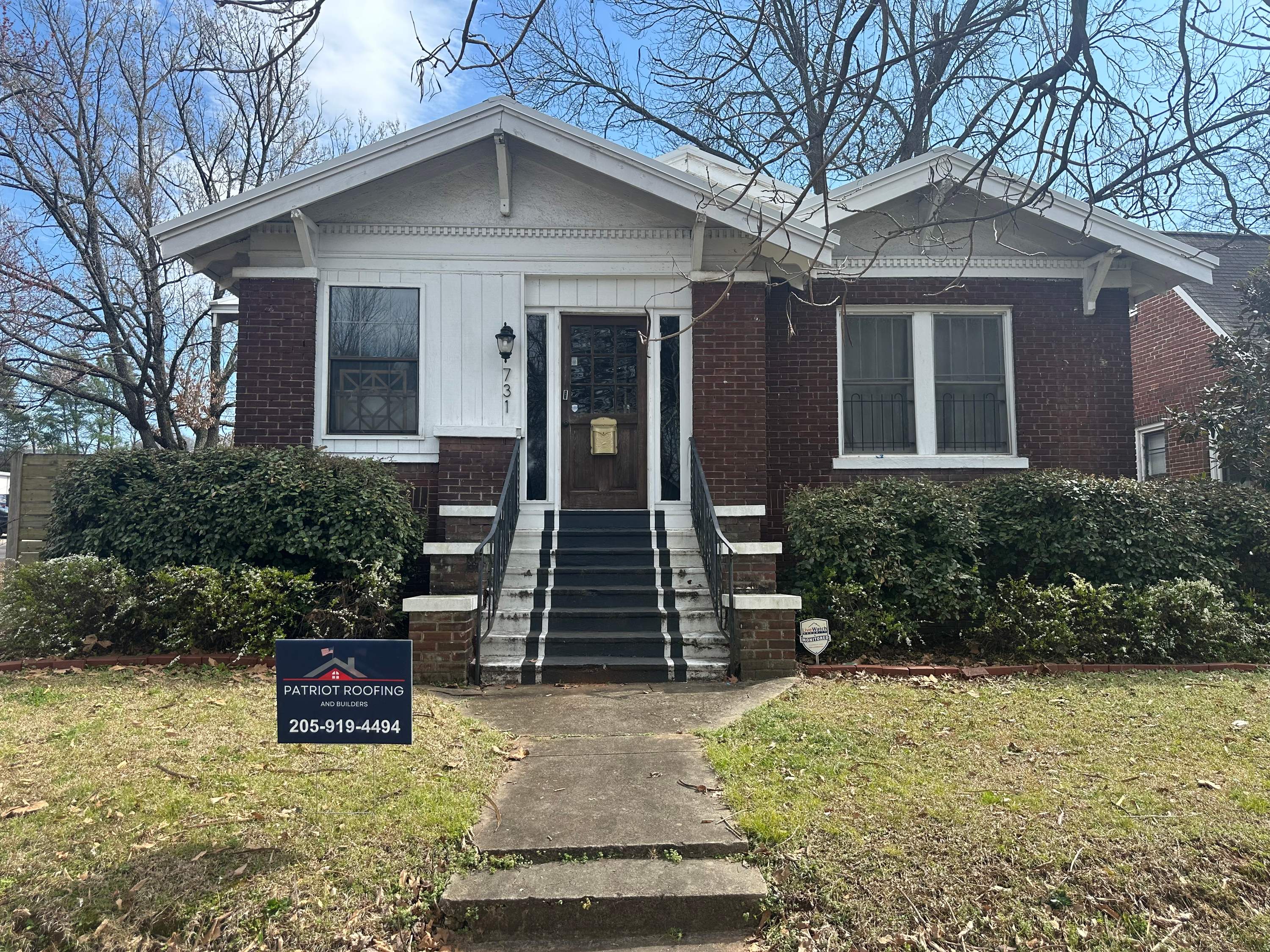
Located in the Glen Iris neighborhood of Birmingham, this brick bungalow received a complete roof replacement. The worn shingles were stripped away to expose the wooden deck, which was then sealed with a protective leak-barrier underlayment. The finished system utilizes light gray standing seam metal roofing panels with defined vertical ribs and matching metal ridge caps. These panels integrate around the existing brick chimney and plumbing vents, updating the home's protection while complementing the dark brick and white trim.
You Might Also Like
Stop Ignoring How Heat Warps Vinyl in Birmingham, AL