

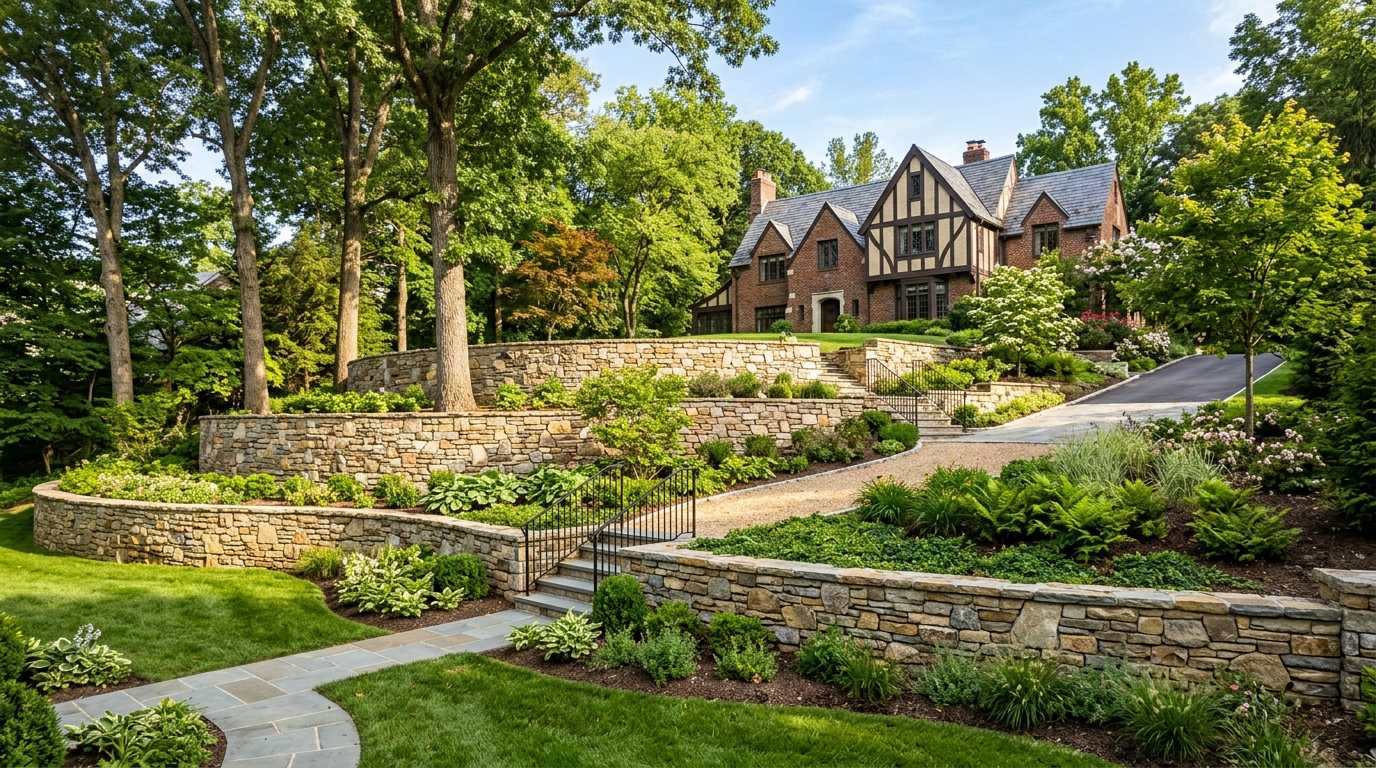
The Hidden Forces Destroying Retaining Walls in Mountain Brook
Heavy Alabama clay and dense tree canopy are the primary culprits behind failing masonry walls in our local estates. When late spring downpours saturate the ground, that soil expands significantly and pushes outward against unreinforced barriers. This intense hydrostatic pressure easily snaps mortar joints and bows thick concrete blocks over time.
I frequently see 1950s structures in Mountain Brook Village leaning dangerously toward the street because they lack proper footings. The original builders simply stacked heavy materials without installing systems to manage the water trapped behind them. Once a wall begins to lean, the structural integrity is entirely compromised.
To permanently fix these issues, we engineer retaining walls in Mountain Brook that manage water flow before it damages the masonry. A properly designed system reclaims unusable hillsides while protecting your foundation from slow-moving mudslides.
Need Retaining Walls in Mountain Brook?
If you're looking for help in Mountain Brook, visit our dedicated retaining walls page for local service details, project examples, and the next steps for your home.
How Alabama Clay Dictates Slope Stabilization Solutions
You cannot build a lasting structure in Jefferson County without managing the extreme expansion and contraction of our local soil. This heavy dirt acts like a giant sponge, placing immense lateral weight against your wall face during heavy rainstorms. Standard landscaping blocks without deep reinforcement will fail rapidly under these conditions.
We combat this pressure by installing mechanically stabilized earth (MSE) systems. My crews use specialized geogrid layers that tie the wall face deep into the excavated hillside. I recently pulled down a bowing cinderblock wall in Brookwood Forest where the sheer force of saturated clay had completely snapped the unreinforced masonry joints.
This synthetic mesh locks the aggregate backfill into a solid mass and distributes the extreme weight across a wider footprint. To prevent these failures, a structurally sound retaining wall installation requires three specific elements:
- Over-excavated trenches filled with mechanically compacted gravel bases.
- Perforated drain pipes laid at the footing level to channel water away.
- Clean angular stone backfill wrapped in commercial-grade filter fabric.
Balancing Historic Aesthetics with Modern Code Requirements
Matching the 1920s Tudor and colonial heritage of Crestline and English Village requires artisan masonry applied over a heavy-duty structural skeleton. You cannot drop industrial blocks into an older estate and expect it to blend with mature hardwoods. The architectural standards of these neighborhoods demand materials that look entirely natural.
We design custom barriers that replicate your home's original brickwork, natural stone, or slate features. Behind that traditional facade, we build a modern, code-compliant core capable of holding back tons of saturated earth. This dual-layer approach provides the classic aesthetic required by older neighborhoods alongside severe-weather performance.
If you are upgrading your home's exterior, coordinating this masonry with premium siding installation services ensures a cohesive look across the entire property. The goal is to make the new engineering look like it has belonged on the estate for a century.
The True ROI of Doing It Right the First Time
A properly engineered retaining wall recoups about 65% of its cost at resale, provided it includes a comprehensive drainage system that prevents future failures. Paying for cheap, unreinforced landscape blocks means you will inevitably pay to tear them down and rebuild within a decade. The initial savings vanish the moment the structure begins to bow.
Water pressure causes nearly all structural collapses in our area. The dense canopy around Jemison Park traps heavy moisture, keeping the ground saturated long after late spring storms pass. We install strategic weep holes and specific aggregate backfill to relieve this hidden pressure continually.
If water is already pooling near your home, pairing a new wall with professional gutter installation keeps roof runoff from dumping directly behind your masonry. Managing water from the roofline down to the foundation is the only way to protect your landscape investment.
Material Selection for Steep Wooded Estates
The right material for your property depends entirely on the height of the slope and the lateral load of the soil. We calculate the exact load-bearing requirements before recommending specific building materials. A four-foot drop requires entirely different engineering than a two-foot garden border.
Heavy-duty engineered concrete blocks are the most cost-effective option for massive earth-moving projects and terraced landscaping. For a more organic look, we use large boulder wall construction that blends seamlessly into wooded lots. If you are creating a new outdoor living space, these terraced levels provide a perfect foundation for custom deck construction.
When evaluating materials for your estate, consider these specific trade-offs:
- Stacked Stone: Offers unmatched historic beauty but requires intensive manual labor and precise joint engineering.
- Engineered Block: Provides maximum lateral strength and cost-efficiency for walls exceeding four feet in height.
- Treated Timber: Works well for low-profile borders under three feet, lasting roughly 15 to 20 years before requiring replacement.
Frequently Asked Questions
How much does a retaining wall cost in Mountain Brook?
Basic timber walls start around $15 to $25 per square foot, while engineered block or custom stone walls run $25 to $50 or more per square foot. The final price depends heavily on the amount of deep excavation required to stabilize our local clay.
How long do these structural walls last?
A properly constructed stone or concrete wall can last 50 to 100 years. The longevity depends entirely on the quality of the drainage system installed behind the masonry face to relieve hydrostatic pressure.
Do I need HOA approval to build a stacked stone wall?
Older neighborhoods like Crestline and English Village generally lack strict HOA restrictions, allowing you to choose materials without architectural review delays. You still need proper municipal permits and engineering plans for structures over four feet tall.
Can terracing fix a steep, unusable hillside?
Yes, multi-tiered systems cut into sharp drops to create flat, functional platforms. This earthwork stops topsoil runoff and reclaims lost square footage for patios or gardens.
Securing Your Property's Foundation
Stabilizing a steep lot requires precise earthwork and a deep understanding of local soil mechanics. Ignoring a leaning structure only increases the risk of a catastrophic mudslide during the next heavy rainstorm. We ensure your hillside remains exactly where it belongs.
My team handles the complete engineering process, from soil evaluation to final masonry finishing. Call our office at (205) 919-4494 to schedule a site evaluation for your property. We will assess your slope, test the soil conditions, and map out a permanent structural solution today.
Ready to stop researching and get real answers?
If this article helped you spot a roofing, siding, or gutter issue, the next step is simple. Get honest guidance, a professional inspection, and a clear plan from the Patriot Roofing team.
Justin Johnson
Owner / Licensed Home Builder
Justin is the Co-Owner of Patriot Roofing & Builders and a Licensed Alabama Home Builder. With extensive experience in high-performance exterior systems and storm restoration, he brings a hands-on, technical perspective to every project across the Greater Birmingham area.
More About UsYou Might Also Like
Why Timber Walls Rot Fast in Homewood, AL
